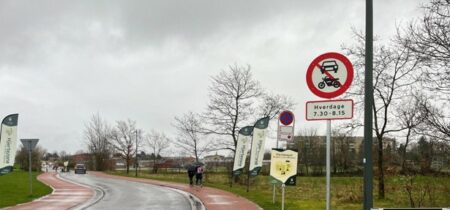

Edge lanes
 Photo: Cycle superhighways, capital region of Denmark
 Edge lanes are better than nothing, but they have little effect. There are issues with parked cars and when cyclists need to turn left.
By Troels Andersen
Edge lanes can be used in rural areas and through villages. In addition to making it possible for cyclists to cycle in the edge lane, they also provide a safer option for walking in a dedicated area in rural areas. So edge lanes are better than nothing.
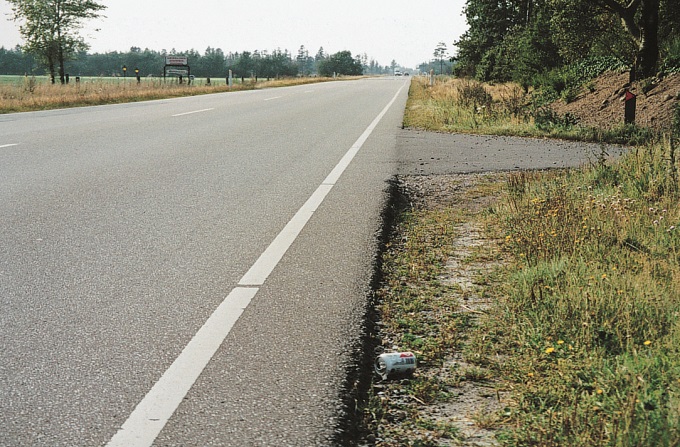
- Edge lanes are somewhat better than nothing.
Furthermore, wide edge lanes address bearing capacity issues along the edge of the traffic lane. The wider the edge lane, the more Danish cyclists find it acceptable. Parking is allowed on the edge lane unless there are no parking signs. Be careful with edge lanes that are too narrow. Cyclists will use the traffic lane and drivers aren’t expecting it.
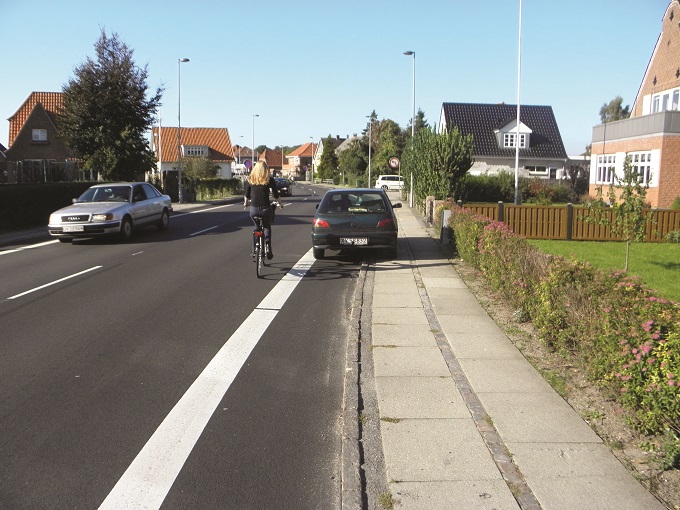
- Parking in the edge lane can mean dangerous situations for cyclists. Photo Troels Andersen
Edge lanes are established by changing the edge line marking or by widening the traffic lane. It is not advisable to widen the traffic lane to make space for an edge lane. Establish a cycle track instead. It costs as much to widen the traffic lane as to establish a cycle track, but edge lanes do little to improve cyclist service levels or cyclist traffic safety. On the other hand, edge lanes do improve driver traffic safety.
Edge lane markings may result in increased driving speeds. Some of the accidents on roads with edge lanes occur with left turning cyclists. Edge and cycle lanes do not generally contribute to the reduction of the number of left turning accidents. However, a left turn lane for cyclists can be established on the right side of the road. This solution has been implemented on several roads in Funen.
Cross profile
The guideline width for edge lanes in urban areas is 1.5 m incl. 0.3 m solid edge line. If that much space is available, it might be better to install a cycle lane instead. In rural areas the guideline width is 1.2 m incl. edge line, and the minimum width is 0.9 meters. 0.3 m wide edge lines may be not be used unless the edge lane width is at least 0.9 m incl. edge line. Otherwise the edge line must only be 0.1 m wide. The edge line must be solid.
There shouldn’t be any gullies in the edge lane since it’s so narrow. A side entry gully is clearly the best solution.

- An edge lane is worthless with this type of gully. Photo Troels Andersen
Edge lane width is crucial for the safety effect in rural areas. Passing, cycling side by side, cargo bikes, and bicycle trailers do not work on narrow edge lanes. Drivers are surprised when cyclists temporarily use the traffic lane.
The edge lane should be 1.5 m wide on roads with bicycle tourists and roads with more than 100 cyclists per day, but a cycle track or a cycle lane is clearly preferable.
A Danish before-and-after study shows that the number of road accidents drops as the width of edge lanes increases. The drop is greatest among light road users.
Sources
Rosbach, Ole (1984): Kantlinier forbedrer både bilisters og cyklisters sikkerhed, Dansk Vejtidsskrift nr. 10, Danmark.
Vejdirektoratet (1992): Cykelstier i Frederiksborg Amt – En brugerundersøgelse, Danmark.
Møller, Jes og Larsen. Flemming (1983): Cykel- og knallertulykker i landområder – Dokumentationsrapport, Vejdirektoratet, Danmark.
CROW (1998): Recommendations for traffic provisions in built-up areas, Record 15, Holland.
Risegaard, Peter (1995): Ny type kantbaner afprøvet i nordjyske byer, Dansk Vejtidsskrift nr. 11.
Ludvigsen, Henrik S. (1982): Cykel- og knallertuheld på veje med kantbaner, Dansk Vejtidsskrift nr. 6.
Rosbach, Ole (1984): Kantlinier forbedrer både bilisters og cyklisters sikkerhed, Dansk Vejtidsskrift nr. 10.